
Bavin V
B.E. Electrical Engieering III Year
Kumaraguru College of Technology
Representing India at Monaco Energy Boat Challenge 2026
Designed at Kumaraguru. Tested at Monaco.
How Team Sea Sakthi turned undergraduate engineering into internationally recognised innovation.
Engineering Beyond the Classroom
Representing India at the Monaco Energy Boat Challenge 2026 placed Team Sea Sakthi in an international arena where engineering ideas had to perform beyond simulations and laboratories. As the Electrical Subsystems Lead, I worked on one of the most critical aspects of the boat—building and integrating an electrical propulsion system capable of performing reliably under demanding competition conditions.
The experience required much more than technical knowledge. It demanded the ability to design, integrate, test, troubleshoot, and make decisions as a team when systems did not behave as expected.
My responsibilities covered the complete propulsion ecosystem—from high-voltage battery architecture and motor controller commissioning to liquid cooling, CAN communication, Battery Management Systems (BMS), and full propulsion-system integration.
The team also developed expertise in high-voltage battery architecture, modular battery packs, Master–Slave BMS configurations, marine electrical safety, telemetry concepts, and low-voltage systems.
Thermal management presented another significant engineering challenge. We designed and validated a liquid cooling system for the battery and motor, combining component benchmarking with thermal analysis and extensive testing. Every stage—from design choices to full-scale validation—required the team to move continuously between theory and real-world performance.
From Components to a Complete System
A major capability developed through the project was understanding how individual engineering components must function as one interconnected system. I worked on the integration of a PMSM-based electric propulsion system using an EMRAX motor and EMDrive controller, including controller commissioning, encoder calibration, current and torque tuning, and CAN-based diagnostics.
The team also developed expertise in high-voltage battery architecture, modular battery packs, Master–Slave BMS configurations, marine electrical safety, telemetry concepts, and low-voltage systems.
Thermal management presented another significant engineering challenge. We designed and validated a liquid cooling system for the battery and motor, combining component benchmarking with thermal analysis and extensive testing. Every stage—from design choices to full-scale validation—required the team to move continuously between theory and real-world performance.
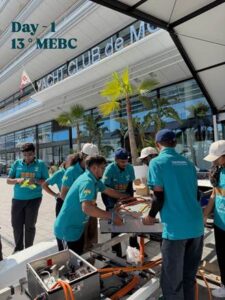
Learning Alongside the World’s Best
One of the most valuable aspects of Monaco was discovering where Team Sea Sakthi stood in a global engineering environment. Many participating teams included postgraduate researchers and experienced engineering students, while Team Sea Sakthi was among the few undergraduate-only teams. Yet, several technical challenges we encountered were the same challenges being addressed by internationally established teams.
That realization was important: engineering excellence is not about avoiding problems; it is about developing the capability to understand, test, troubleshoot, and improve.
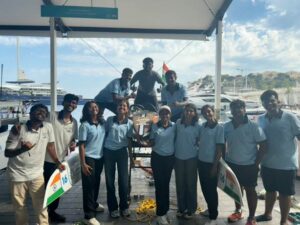
Observing solutions developed by other teams also changed the way we approached engineering decisions. Some concepts we had previously set aside were being successfully implemented by high-performing international teams. It reinforced the importance of global benchmarking, questioning assumptions, and remaining open to revisiting earlier design choices.
Technical discussions with students, researchers, and industry experts further exposed us to advanced marine propeller optimization, international approaches to electric boat development, multidisciplinary teamwork, and different engineering cultures.
More Than a Competition
Monaco strengthened our technical capabilities, but its larger impact was on how we think as engineers.
We returned with a stronger appreciation for systems thinking, experimentation, global benchmarking, interdisciplinary collaboration, and engineering under real-world constraints.
Most importantly, the experience showed us that an undergraduate student team can do more than participate on an international stage. With the right combination of technical depth, persistence, teamwork, and willingness to learn, it can contribute ideas that earn recognition alongside some of the world’s emerging engineering talent.
When Engineering Earns Recognition
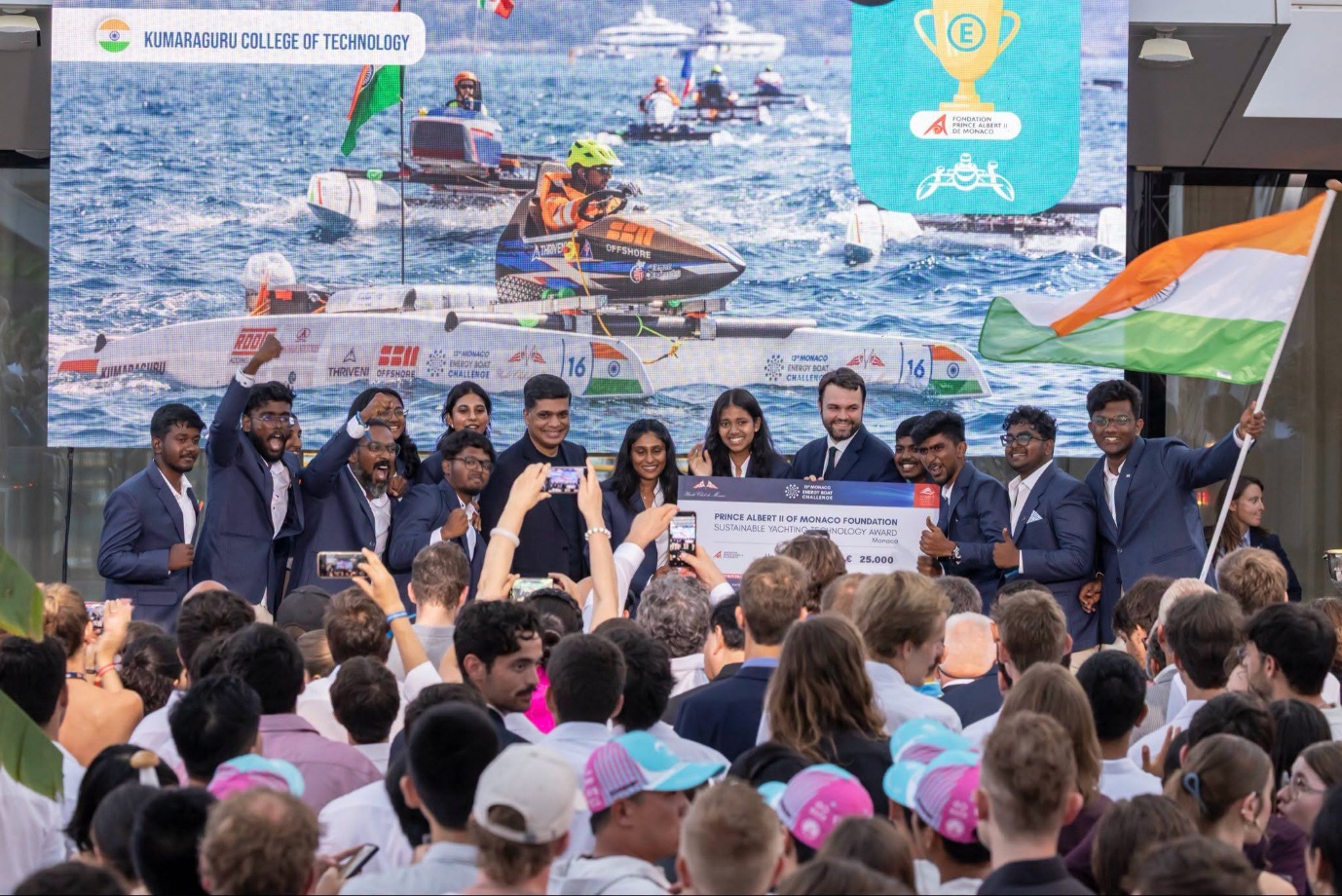
The defining moment came when Team Sea Sakthi received the Prince Albert II of Monaco Foundation Prize, along with a €25,000 Startup Grant, for our innovative custom lithium-ion battery pack cooling system.
For the team, the recognition represented more than an award. It validated our ability to take an engineering problem, develop our own solution, test it under demanding conditions, and demonstrate its relevance on an international platform.